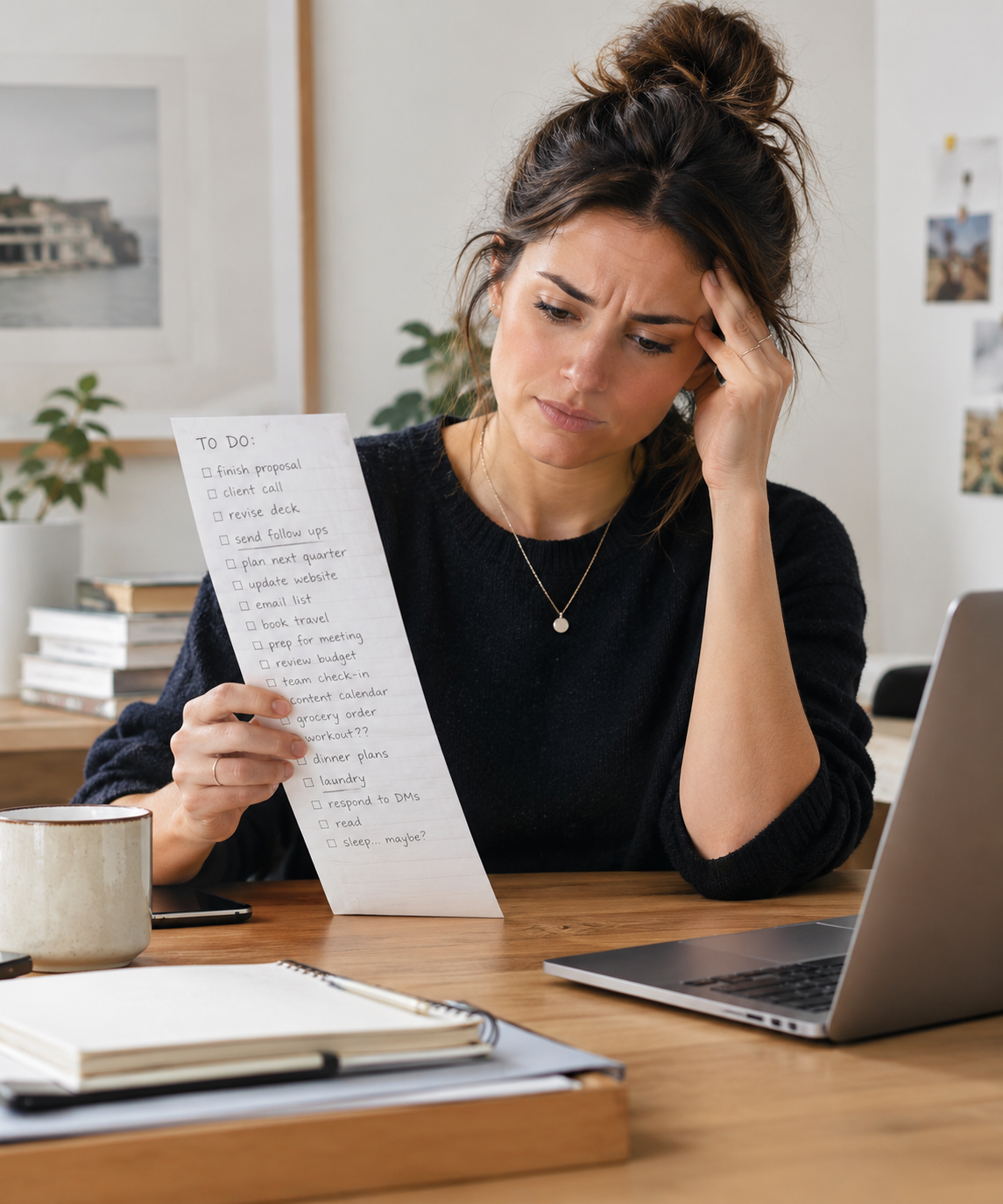
It's 2 a.m. and you're lying in bed staring at the ceiling. The kids are asleep. Your biggest client paid on time this month. Your partner isn't upset about anything. Your life looks great on paper. And yet your chest is tight, your mind is looping through tomorrow's to do list for the third time, and your body feels like it's bracing for battle. You keep asking yourself: Why am I always anxious even when there’s no reason to be?
Anxiety can show up even when you're logically safe because it's driven by brain and body patterns, not only conscious thoughts. It affects 40 million adults in the U.S. annually, and women – especially mothers managing businesses and families – are disproportionately represented. Feeling anxious even when everything seems fine is common and often stems from hidden physical triggers, unprocessed stress, or a nervous system that's been running on high for too long.
I work with women who look like they have it all together but are constantly struggling with a body and brain that won't stop sounding the alarm. Here are some of the most common causes behind this kind of anxiety and what you can do about it.
Is Everything Really "Fine"?
Before we get into it, let's challenge the premise of fine for a moment.
Consider what a typical week looks like for a small-business-owning mom in late 2026. You’re navigating AI changes reshaping your industry, keeping track of payroll and taxes, responding to client emails, managing your kid's school schedule and the new extracurricular they want to try, keeping up with friends and your partner, doomscrolling awful global news at night, fending off existential dread, dealing with inflation on both business supplies and groceries, and doing whatever else you need to do to stay ahead (or afloat) in life. You might be used to managing that level of chaos, but it’s not really "fine." It’s a lot.
It’s okay to acknowledge that it’s a lot. Admitting it to yourself doesn’t make you a failure or mean you have to drastically alter your entire life and quit everything. Being honest with yourself is just the first step toward feeling better.
Okay, now onto ten common causes of anxiety in high-functioning women.

10 Reasons You Feel Anxious All the Time
1. Your nervous system is stuck in fight or flight
Past stress or trauma trains your body to stay on high alert. You might be dealing with untreated trauma that you’ve either pushed into your dustiest brain closet in an attempt to stay afloat or don’t even know about. A nervous system that learned to stay vigilant doesn’t always know how to power down, even when life is stable and there’s no immediate threat. Calm or quiet moments can feel unsafe, and your mind can interpret "nothing is happening" as "something bad is about to happen."
2. You’re running on constant busyness
When you’re always on, whether it’s client calls, school pickups, meal planning, or answering urgent emails, your body never gets a real chance to come down. Busyness is an excellent coping strategy to outrun uncomfortable feelings, but you can’t run forever. The moment you slow down or rest, the anxiety catches up with you.
3. It could be Generalized Anxiety Disorder (GAD)
Generalized Anxiety Disorder involves ongoing, excessive worry that feels out of proportion to your circumstances and lasts for months or longer. If your worry follows you from situation to situation regardless of how things are actually going, it’s worth talking with a professional. GAD can stem from trauma, PTSD, or other mental health issues, so this might be one piece of a bigger puzzle.
4. Burnout is taking over
Burnout affects your brain, your mood, your energy, and your stress levels. For business owners and moms, the line between tired and burned out can be blurry. You might believe that if you stop or take a break, everything you’ve worked so meticulously to keep together might immediately self-destruct, so you keep pushing and pushing. When your reserves are always running low, your body starts to rely on stress hormones like cortisol and adrenaline to get by, and anxiety is much likelier to crop up.
5. Uncertainty feels unsafe
Anxiety can be a result of being uncomfortable with uncertainty. Maintaining control in all the aspects of your life is impossible and puts a ton of pressure on you. It can also feel impossible to stop trying to keep everything within your control. When you’re the one holding the family and the business together, it makes sense that you’d want to stay a step ahead of every problem. But the less you’re able to tolerate uncertainty, the stronger anxiety and overwhelm get.
6. Perfectionism and people-pleasing
If you rely on learned coping skills like perfectionism or people-pleasing to earn love and avoid rejection, anxiety comes with the territory. Constantly worrying about everyone else’s feelings, attempting to manage people’s emotions and soften blows, and being afraid that one misstep will blow your cover and out you as an imposter means that you’re always just one mistake away from losing everything. Or at least that’s what your brain tells you.
7. Hormonal, physiological, and lifestyle factors
Sometimes the cause is physical, or partly physical. Poor sleep, high caffeine intake, skipped or irregular meals, limited movement, perimenopause, chronic illness, and thyroid changes can all mimic or worsen anxiety. If your anxiety seems to come out of nowhere, it’s worth checking in with your habits or your doctor to rule these out.
8. You aren’t getting the support you need
A lot of the high-achieving women I work with aren’t getting what they need from their relationships. Their partner, for example, might feel like one more person they have to take care of. You might be making all the appointments, cooking all the dinners, dropping the kids off at school and sports practices, reminding your partner about the parent-teacher conferences, and asking for the third time this week whether they remembered to pack your kids’ lunches. Working with your partner to make sure you’re both sharing the load equitably plays a huge role in dialing down your anxiety.
9. Your work-life balance is off kilter
You might be so busy juggling being a mom and trying to maintain or grow your career that you don’t have enough time to dedicate to things that are just for you. Maybe you don’t have many close friendships, you don’t have time for things you enjoy, or you can’t fit hobbies into your schedule. When your life lacks community, creativity, play, and pleasure, anxiety and depression are more likely to seep in.

10. You weren’t taught the skills you need to thrive
You can’t thrive if you haven’t learned how to show up fully as yourself in the world. Fear-facing, self-compassion, ability to tolerate discomfort, ability to voice what you really need and think, conflict resolution skills, and nervous system grounding tools are all important skills to build resiliency and handle all the things life throws at you. There’s absolutely no shame in not having developed these skills. Most of us were never taught them, or were actively discouraged from practicing them. But as adults, it’s our job to learn them and break patterns that hurt us.
What Can Help
Feeling anxious when everything is “fine” doesn’t mean you’re ungrateful or that something is wrong with you. It usually means your mind and body have been carrying too much for too long.
I’m not going to tell you to overhaul your life or give up all your responsibilities. As one mom who runs a small business to another, I’ll tell you that’s not an answer I would have ever accepted, and it probably isn’t one you will either.
But you can still take steps toward feeling better, even if you don’t know the exact cause of your anxiety. Here are a few small places to begin:
Give your body an outlet.
People need fresh air, sunlight, and exercise to function well, and you are not excluded from that. Walking, stretching, or even a few intentional and slow breaths between tasks can help your nervous system release some stress for a moment.Build in real pauses
Not scrolling, not catching up, just a few seconds or a minute of nothing. Notice the discomfort you feel when you do nothing. Keep practicing, and your tolerance for that discomfort will build.Notice your patterns
Does anxiety spike during quiet moments, certain times of day, or in specific situations? Patterns offer clues. Jot them down in a journal or a mood-tracking app to try and figure out what might be adding to your anxiety.Talk to a mental healthcare provider
Consider working with a coach or therapist who has experience with anxiety and burnout in high-achieving women. (Hi, it’s me!) Working 1:1 with a professional is a great way to understand why your system stays on alert, develop tools to use in your life that can help you feel better, and teach you skills to cope with life stressors.Try evidence-based therapies
Therapeutic approaches like EMDR, internal family systems therapy, or body-based (also known as somatic) therapy teach you how to access safety in your body and mind.Talk to your doctor about medication
For some people, medication can be a really important part of anxiety management. Medication can also be really helpful in managing things like GAD and phobias. Plus, new and emerging studies on physiological changes that cause perimenopause and menopause point to benefits of using hormonal replacement therapy or antidepressants for mood and sleep regulation.
Support for High-Achieving, Anxious Moms
Your life can be full and demanding without your body feeling like it's in crisis all the time.
If you're a high-achieving mom who recognizes herself in this article, I’d love to help. I work with high-achieving women and mothers who want to step off the hamster wheel of anxiety, and burnout and find more balance in their lives. If you’re curious, reach out for a free consultation to learn more.
Feeling successful but stretched thin? You don’t have to wait until you’re burned out to want things to feel easier.
The Balanced Boss is one-on-one coaching for women who want their success to feel steady, sustainable, and actually enjoyable.

MEET THE AUTHOR
Justine Carino
Justine is a licensed mental health counselor with a private practice in White Plains, NY. She helps teenagers, young adults and families struggling with anxiety, depression, family conflict and relationship issues. Justine is also the host of the podcast Thoughts From the Couch.
Recent Posts